Network active
N=0
Stealth Mode · Active Development
SwarmGuard
Built to resist. Designed to adapt. Distributed to outlast.
Powered by
SIL™
SIMULATION
Built to resist. Designed to adapt. Distributed to outlast.
We still judge autonomous systems on peak performance in ideal conditions. But the real test is what happens when the network fragments, when the signal drops, when a node stops responding.
Jamming. Signal degradation. Denied infrastructure. Partial connectivity. These aren't edge cases anymore — they're the work environment.
Centralizing coordination concentrates the risk. When the center goes down, the mission goes with it.
Most systems optimize execution in the nominal scenario. SwarmGuard starts from the opposite: what has to hold when things go wrong.
SIL™ rests on three primitives. They're what lets the swarm hold when everything else gives way.
The swarm isn't locked into a fixed formation. It reorganizes as the mission evolves or as nodes drop out.
Before a critical action runs, peers have to agree and sign off on it. The quorum required adjusts to the situation.
Every node is watched continuously. When behavior drifts, the swarm catches it, isolates the node, and continues without it.
SIL™ doesn't fly anything and doesn't decide alone. It makes sure decisions come up, get validated, and are signed before anything executes. Above the hardware. Above the models. Above the platforms.
Hardware can be replaced. Coordination can't. That's where the strategic value lives.
AI proposes. SwarmGuard decides.
No critical action without peer validation.
No simulation. No slides. Four nodes in continuous operation, stress-tested across three operational scenarios: nominal operation, node failure, and compromised node.
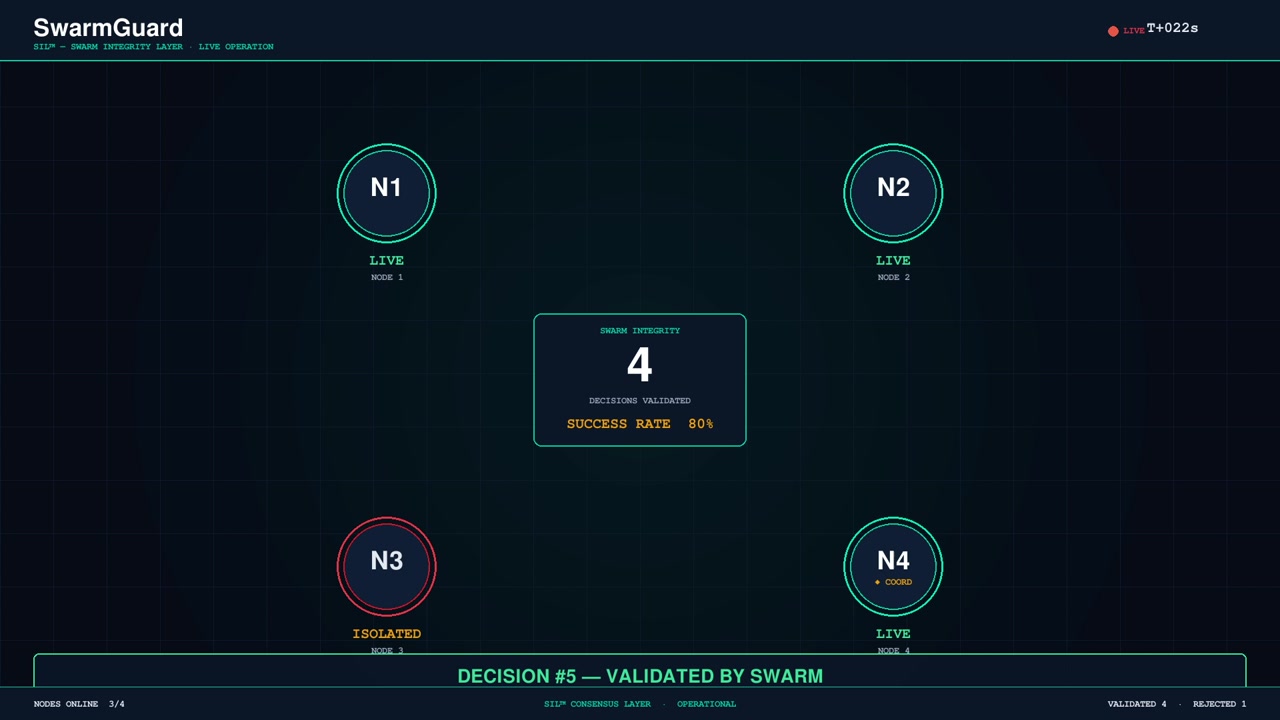
Implementation details available under NDA after mutual qualification.
Where the command link isn't guaranteed. Where it can be jammed at any moment.
Inspections in remote areas. Mapping under degraded conditions. If one aircraft drops out, the work has to keep going.
Robots that need to coordinate without a central supervisor. Sites too remote to depend on a stable link.
In defense, you have to know where you stand before someone asks. Here's where we stand.
We work within Canadian export controls and the legal frameworks of allied jurisdictions. No engagement with sanctioned states or non-state actors. The rule of law sets the boundary, not slogans.
Our tech coordinates. It doesn't decide on lethal use by itself. On anything that risks a life, a human signs off.
Export controls, Quebec's Loi 25, CCCS requirements. We won't cut corners to close a deal faster.
We say publicly what we stand for. The sensitive technical details, we keep. That line is clear and it isn't up for negotiation.
This isn't a marketing page. It's a filter. If it matches you, let's talk. If not, we're probably not the right partner — and that's fine.
Three years on it: how to keep a swarm coherent when a node falls, lies, or is attacked. A lot of dead-ends before finding what holds. The thesis gave the answer. SwarmGuard puts it in the field.